



Current page
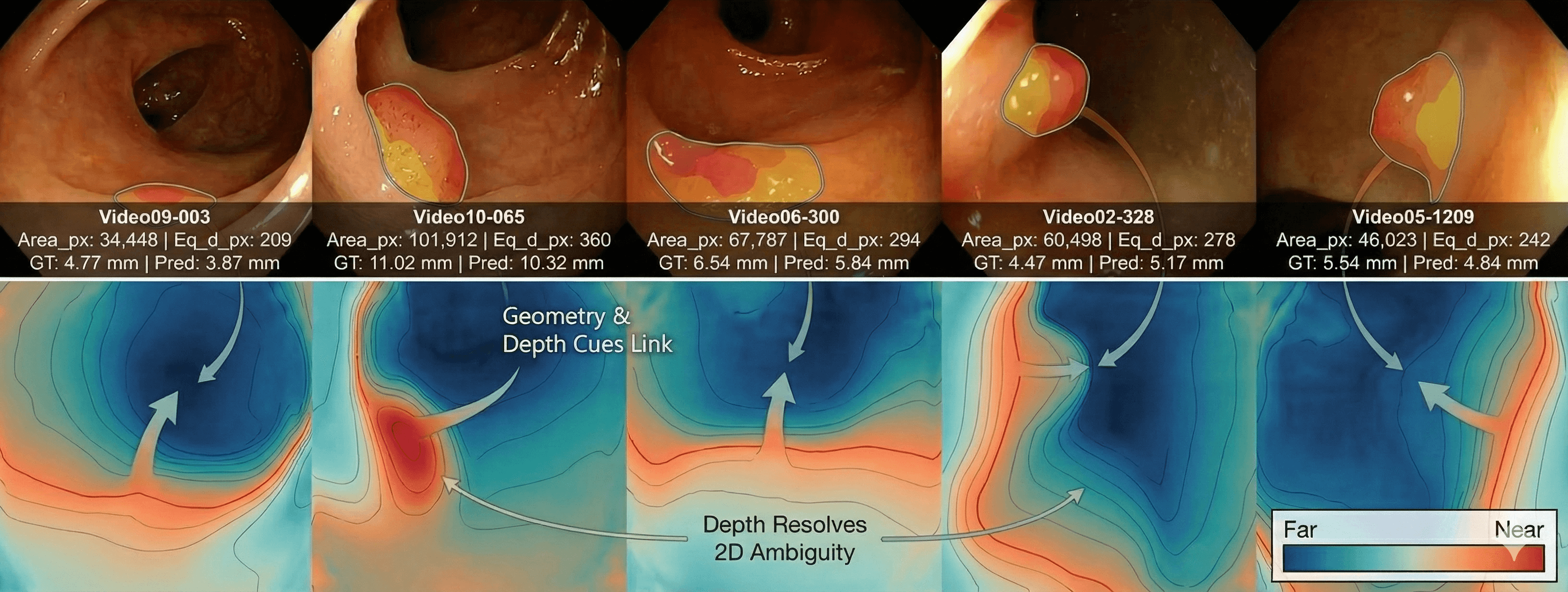
Geometry-Aware Depth-Guided Explainable Multimodal Polyp Size Estimation: A Fusion Model Beyond RGB
Geometry-Aware Depth-Guided Explainable Multimodal Polyp Size Estimation: A Fusion Model Beyond RGB
Geometry-Aware Depth-Guided Explainable Multimodal Polyp Size Estimation: A Fusion Model Beyond RGB
Conference:
Conference:
MIDL 2026
MIDL 2026
Keywords:
Keywords:
Polyp Size Estimation, Multimodal Learning, Depth Estimation, Geometry-Aware Models, Explainable AI
Polyp Size Estimation, Multimodal Learning, Depth Estimation, Geometry-Aware Models, Explainable AI
Wireless capsule endoscopy operates under photon-limited conditions where spatially varying illumination attenuation and resolution degradation obscure fine anatomical structures. Conventional super-resolution methods may amplify unstable high-frequency content, producing visually sharp yet structurally unreliable outputs. We propose RCD-SR, a reliability-conditioned diffusion framework that jointly couples illumination stabilization and super-resolution via spatial confidence modulation. A Retinex-inspired decomposition estimates illumination and recoverable structure, while a confidence map regulates generative refinement during diffusion sampling, constraining amplification in low-signal regions. Without paired ground truth, evaluation is performed using no-reference and relative-reference metrics at ×4 upsampling. RCD-SR demonstrates improved structural alignment, controlled frequency behavior, and reduced artifact amplification compared to existing methods. This approach provides a principled solution for hallucination-aware reconstruction in photon-limited medical imaging.
Wireless capsule endoscopy operates under photon-limited conditions where spatially varying illumination attenuation and resolution degradation obscure fine anatomical structures. Conventional super-resolution methods may amplify unstable high-frequency content, producing visually sharp yet structurally unreliable outputs. We propose RCD-SR, a reliability-conditioned diffusion framework that jointly couples illumination stabilization and super-resolution via spatial confidence modulation. A Retinex-inspired decomposition estimates illumination and recoverable structure, while a confidence map regulates generative refinement during diffusion sampling, constraining amplification in low-signal regions. Without paired ground truth, evaluation is performed using no-reference and relative-reference metrics at ×4 upsampling. RCD-SR demonstrates improved structural alignment, controlled frequency behavior, and reduced artifact amplification compared to existing methods. This approach provides a principled solution for hallucination-aware reconstruction in photon-limited medical imaging.
Other Published
Other Published
Contact Information
USA (HQ)
Boston
Malaysia
Kuala Lumpur
India
Hyderabad
Email Address
contact@screenwithpeek.com
©
2026
Equitable Technologies Inc. All rights reserved.
Our Offices
Boston (HQ)
Kuala Lumpur
Hyderabad
Email Address:
contact@screenwithpeek.com
©
2026