



Current page
Computer Assisted Intervention to Improve Diagnostic Yield in Capsule Endoscopy Post Ingestion
Computer Assisted Intervention to Improve Diagnostic Yield in Capsule Endoscopy Post Ingestion
Computer Assisted Intervention to Improve Diagnostic Yield in Capsule Endoscopy Post Ingestion
Conference:
Conference:
IPCAI 2026 / IJCARS Special Issue
IPCAI 2026 / IJCARS Special Issue
Keywords:
Keywords:
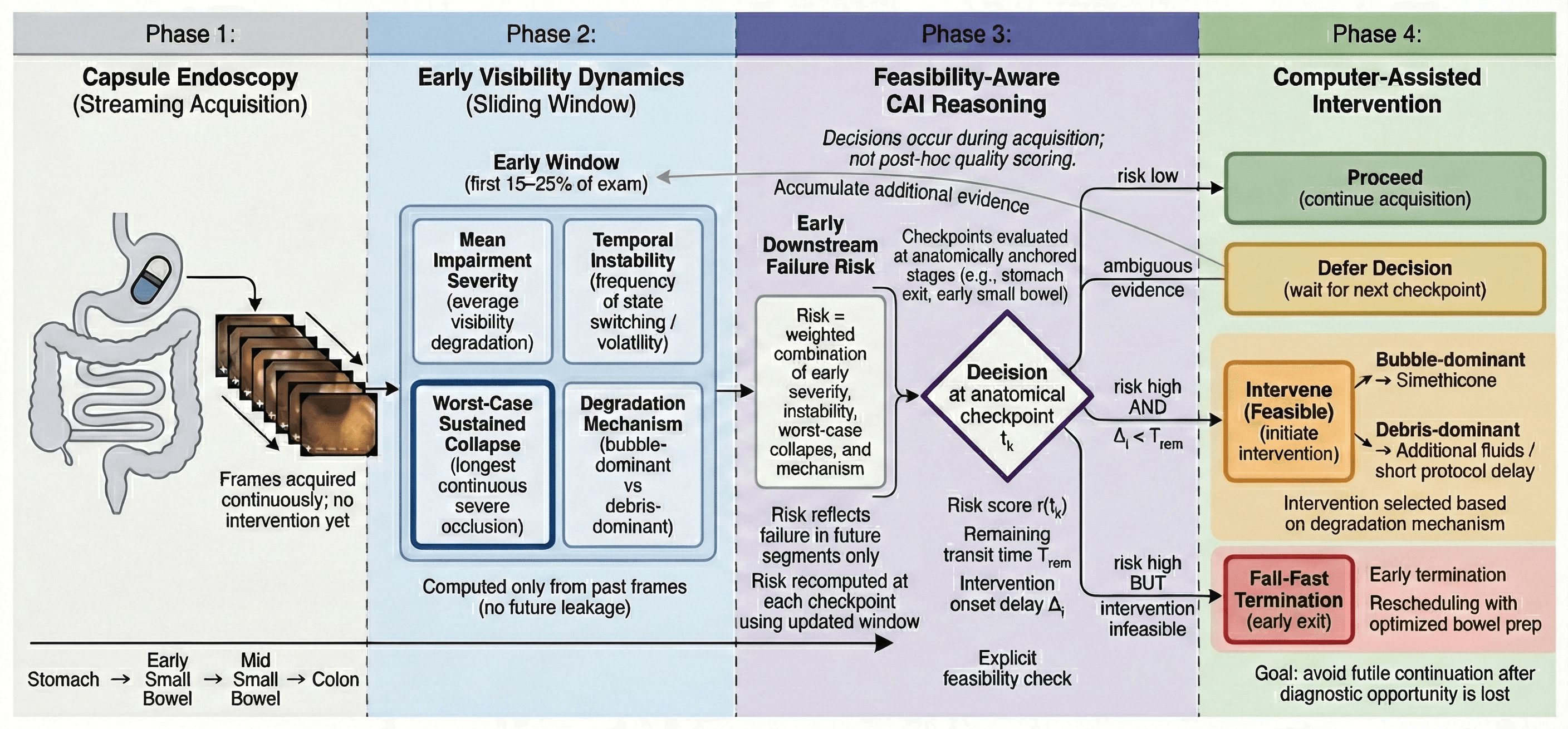
Capsule Endoscopy, Computer Assisted Intervention, Early Failure Prediction, Image Quality Assessment, Sequential Decision Making
Capsule Endoscopy, Computer Assisted Intervention, Early Failure Prediction, Image Quality Assessment, Sequential Decision Making
Wireless capsule endoscopy operates under photon-limited conditions where spatially varying illumination attenuation and resolution degradation obscure fine anatomical structures. Conventional super-resolution methods may amplify unstable high-frequency content, producing visually sharp yet structurally unreliable outputs. We propose RCD-SR, a reliability-conditioned diffusion framework that jointly couples illumination stabilization and super-resolution via spatial confidence modulation. A Retinex-inspired decomposition estimates illumination and recoverable structure, while a confidence map regulates generative refinement during diffusion sampling, constraining amplification in low-signal regions. Without paired ground truth, evaluation is performed using no-reference and relative-reference metrics at ×4 upsampling. RCD-SR demonstrates improved structural alignment, controlled frequency behavior, and reduced artifact amplification compared to existing methods. This approach provides a principled solution for hallucination-aware reconstruction in photon-limited medical imaging.
Wireless capsule endoscopy operates under photon-limited conditions where spatially varying illumination attenuation and resolution degradation obscure fine anatomical structures. Conventional super-resolution methods may amplify unstable high-frequency content, producing visually sharp yet structurally unreliable outputs. We propose RCD-SR, a reliability-conditioned diffusion framework that jointly couples illumination stabilization and super-resolution via spatial confidence modulation. A Retinex-inspired decomposition estimates illumination and recoverable structure, while a confidence map regulates generative refinement during diffusion sampling, constraining amplification in low-signal regions. Without paired ground truth, evaluation is performed using no-reference and relative-reference metrics at ×4 upsampling. RCD-SR demonstrates improved structural alignment, controlled frequency behavior, and reduced artifact amplification compared to existing methods. This approach provides a principled solution for hallucination-aware reconstruction in photon-limited medical imaging.
Other Published
Other Published
Contact Information
USA (HQ)
Boston
Malaysia
Kuala Lumpur
India
Hyderabad
Email Address
contact@screenwithpeek.com
©
2026
Equitable Technologies Inc. All rights reserved.
Our Offices
Boston (HQ)
Kuala Lumpur
Hyderabad
Email Address:
contact@screenwithpeek.com
©
2026